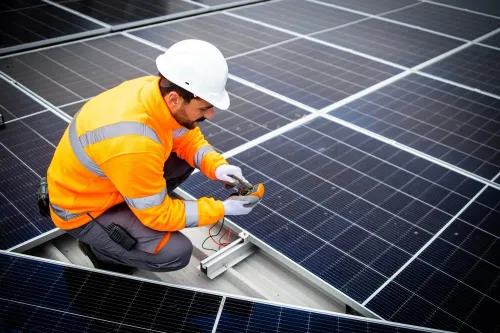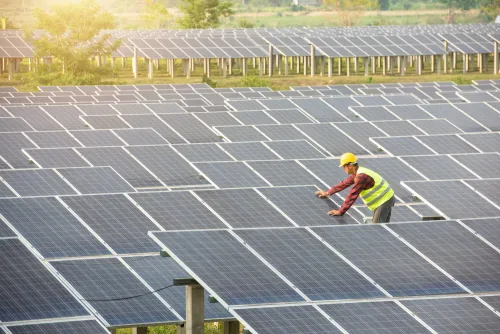
An off-grid installation succeeds or fails before the panels reach the roof: the load schedule, site conditions, battery plan, and protection settings must match one another. By the end, you will know what the installer should measure, calculate, build, test, and document before you accept the system.
Key takeaways
- List every appliance, operating hour, seasonal load, and starting surge before ordering.
- Use a solar site survey to record roof, shade, wiring, safety, and equipment locations.
- Size panels, inverter, and batteries from real energy use and peak demand.
- Request test results, warranties, manuals, drawings, and maintenance guidance at handover.
What must be decided before equipment is ordered?
Before equipment is ordered, define what must run, when it runs, and how long it must remain powered. A monthly electricity bill is not enough for an off-grid solar system: record each appliance, quantity, rated watts, daily operating hours, seasonal use, and starting surge.
1. Create a load schedule. Separate essential loads, such as lights, refrigeration, water pumps, communications, and medical equipment, from non-essential loads. State which appliances may operate together and which can be switched off during low battery conditions.
2. Set the backup expectation. Specify the required autonomy in hours or days without useful sunlight, the minimum battery reserve, and whether a generator will recharge the batteries or run selected loads. “Backup” must also state which loads remain available; powering every appliance through a storm requires a larger battery and inverter.
3. Define the system type. Confirm whether the property is fully off-grid, whether a generator is included, and whether any future grid or generator integration is planned. A grid connection removed from a PV design is not an off-grid system; storage and controls must maintain supply when solar production is zero.
4. Record electrical limits before requesting prices. Identify motor and compressor starting currents, inverter continuous and surge ratings, battery voltage, and cable-run lengths. At 48 volts, a 3-kW load draws about 62.5 amps before losses; at 12 volts, it draws about 250 amps.
Give this schedule and these decisions to a solar energy company and request an itemised quotation showing array, inverter, charge controller, battery capacity, generator interface, protection equipment, and installation assumptions.
What does a solar site survey record?
A solar site survey must capture measured site conditions, not estimates copied from an electricity bill. The solar installer uses this record to size equipment, choose mounting methods, and identify constraints before design begins.
1. Record physical dimensions: roof or ground-mount area, orientation, tilt, usable dimensions, roof condition, structural members, soil or foundation conditions, and space for panels, inverter, batteries, and protection equipment.
2. Map shade from trees, chimneys, parapets, poles, and buildings at different times, including low-sun winter periods. Note the observation dates, shading method, obstructions, and design assumptions; partial shade on one module can reduce a series string’s output.
3. Record electrical demand from an appliance-by-appliance load schedule: wattage, quantity, operating hours, seasonal use, priority, running current, and starting or surge current. Include existing wiring, distribution-board capacity, system voltage, earthing, generator connection, cable lengths, and proposed cable routes.
4. Document environmental conditions that affect equipment: heat, dust, humidity, corrosion risk, flooding, wind exposure, snow or other obstruction, and battery ventilation requirements. These conditions influence ratings, clearances, enclosure selection, and expected losses.
5. Record access and safety details: vehicle approach, lifting routes, roof access, working platforms, service clearances, fire exits, cable-penetration points, and battery isolation locations. Verify local electrical, structural, fire, and battery-storage rules, including NEC Articles 690 and 706 where applicable.
How are the array, inverter, and battery bank sized?
A 5 kWh daily load does not automatically require a 5 kW solar array. The installer builds a load schedule from appliance wattage, quantity, operating hours, priority, and starting current, then calculates daily energy in kilowatt-hours and the highest simultaneous demand in kilowatts. A monthly bill alone cannot reveal either figure.
The array is sized from the least favourable solar season, not the panel nameplate rating. The calculation allows for high module temperature, dust, shading, mismatch, cable loss, charge-controller and inverter conversion, battery charging, and other site losses. The designer then checks whether the resulting production covers daily consumption and restores the battery after cloudy weather.
The inverter must cover continuous demand and short starting surges. A suitable rating is checked against loads such as:
- Pumps and compressors
- Refrigerators and air-conditioners
- Power tools with motor startup
A system with enough daily energy can still trip if its inverter cannot supply the surge.
Battery capacity starts with the autonomy target: the number of days you need power without useful solar generation. A working formula is nominal battery energy = daily load × autonomy days ÷ allowable depth of discharge ÷ system efficiency.
The designer then selects battery voltage and confirms temperature limits, charge current, cable ampacity, and voltage drop.
At 48 V, a 3 kW load draws about 62.5 A before losses; at 12 V, it draws about 250 A. These checks turn an off-grid solar system into a supply that can actually start, run, and recover from its expected loads.
What happens during installation and commissioning?
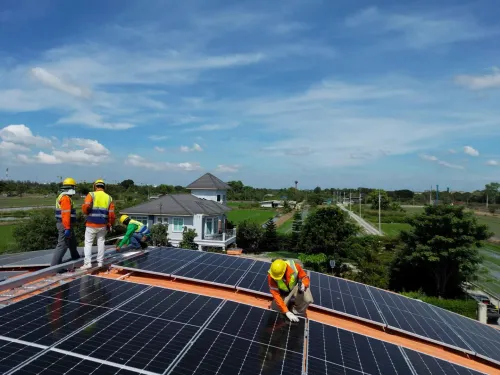
Construction must be complete before any live test: the solar installer secures the array, installs the battery bank and inverter, finishes cable routes, and fits every required isolator, fuse, breaker, gland, conduit, label, and protective earth connection. A loose roof anchor, unsupported cable, or unsealed outdoor entry can become a structural, fire, or shock hazard.
The installer then checks the installation against the approved drawings and local electrical, building, fire, and battery-storage rules. In the United States, that review includes NEC Article 690 for photovoltaic wiring, Article 706 for energy-storage systems, and local fire-code requirements.
Electrical checks must be recorded before the battery or array is connected to the inverter. The following results matter:
| Test | What it confirms | Failure consequence |
|---|---|---|
| Polarity and open-circuit voltage | Positive and negative conductors are correctly identified and voltages match design | Reverse connection or inverter damage |
| Continuity and insulation resistance | Conductors are unbroken and not leaking to earth | Fault current, nuisance trips, or shock risk |
| Protective-earth continuity | Frames, enclosures, and equipment bonds connect to earth | Faults may leave metalwork dangerous |
| Torque and visual inspection | Terminals are tight, labelled, and free from exposed copper | Heating, arcing, or loose connections |
| Battery voltage and polarity | The bank matches the inverter’s voltage setting | Immediate equipment damage or shutdown |
Only after these checks does the installer program charge limits, battery depth-of-discharge limits, low-voltage cut-off, generator input, and load priorities. Commissioning then tests solar charging, inverter output, automatic shutdowns, alarms, and representative loads, including motor starting surges.
What should you receive at handover?
Do not accept the keys without a handover pack. For a solar energy company, off grid solar system installation is complete only when you can identify every component, operate it safely, and prove that commissioning tests passed.
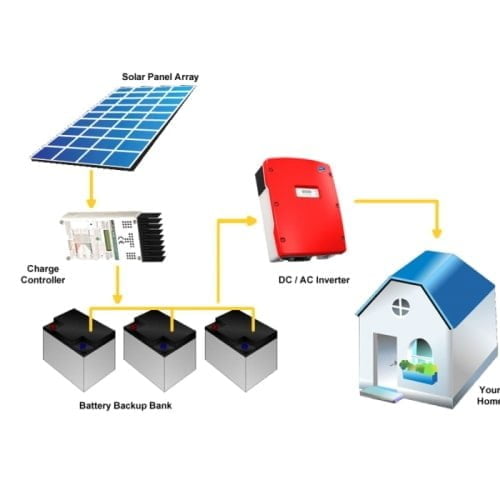
- As-built single-line diagram showing the array, isolators, inverter, charge controller, battery bank, generator or other backup source, earthing, cable sizes, and protective-device ratings.
- Array layout, equipment models, serial numbers, battery chemistry, usable-capacity assumption, programmed voltage and state-of-charge limits, warranty documents, and monitoring login credentials.
- Commissioning records covering polarity, insulation resistance, earth continuity, protective-device operation, battery voltage, inverter settings, alarms, and functional tests under representative loads.
- Demonstrations of normal startup and shutdown, emergency shutdown, alarm acknowledgement, battery-state checks, generator changeover, and safe isolation before maintenance.
| Handover evidence | What it proves | Risk if missing |
|---|---|---|
| As-built diagram and settings sheet | The installed system matches the operating configuration | Unsafe isolation or incorrect replacement parts |
| Test records and alarm demonstration | Protection and controls were checked before use | Faults remain hidden until equipment or wiring fails |
| Maintenance schedule and monitoring access | You can detect declining output, battery capacity, soiling, shading, loose connections, or ventilation problems | Gradual performance loss goes unnoticed |
The maintenance instructions must state inspection intervals for modules, mounting hardware, connectors, cable entries, battery ventilation, vegetation, alarms, and measured production. SOLSKEN ENERGY LLP should also identify the responsible solar energy company contact and the procedure for reporting faults.
Related product
 | Off-Grid Solar System Installation Off-Grid Solar System Installation Solsken Energy LLP specializes in Off-Grid Solar System Installation for locations where grid electricity is unavailable, unreliable, or frequently... |
Frequently asked questions
What must be decided before an off-grid solar system is ordered?
Define which appliances must run, when they run, and how long they must remain powered. Record each appliance’s quantity, rated watts, daily operating hours, seasonal use, and starting surge.
What does a solar site survey record?
A solar site survey records the proposed array location, available space, shading, orientation, structural conditions, cable routes, equipment locations, and site safety requirements.
How are an off-grid array, inverter, and battery bank sized?
Use the recorded daily energy consumption and peak demand to size the solar array and inverter, then size the battery bank around required runtime, usable capacity, and the loads that must remain powered.
What should you receive when an off-grid solar installation is handed over?
Request commissioning and test results, system drawings, equipment manuals, warranty documents, operating instructions, maintenance guidance, and a record of the installed equipment.
Keywords