A grid-tied rooftop system normally shuts down during a utility outage, so solar panels alone will not keep your lights or refrigerator running. You will be able to compare system types, estimate the battery and inverter capacity you need, and identify the Jaipur-specific installation details that determine whether backup works in practice.
Key takeaways
- Size batteries from essential-load watts, backup hours, and a DoD limit.
- Use a transfer switch to isolate backup circuits from Jaipur’s utility grid.
- Demand battery warranty terms, inverter ratings, protections, and commissioning tests in writing.
- Choose equipment rated for Jaipur heat, dust, and monsoon moisture.
What a Hybrid System Does During a Jaipur Power Cut
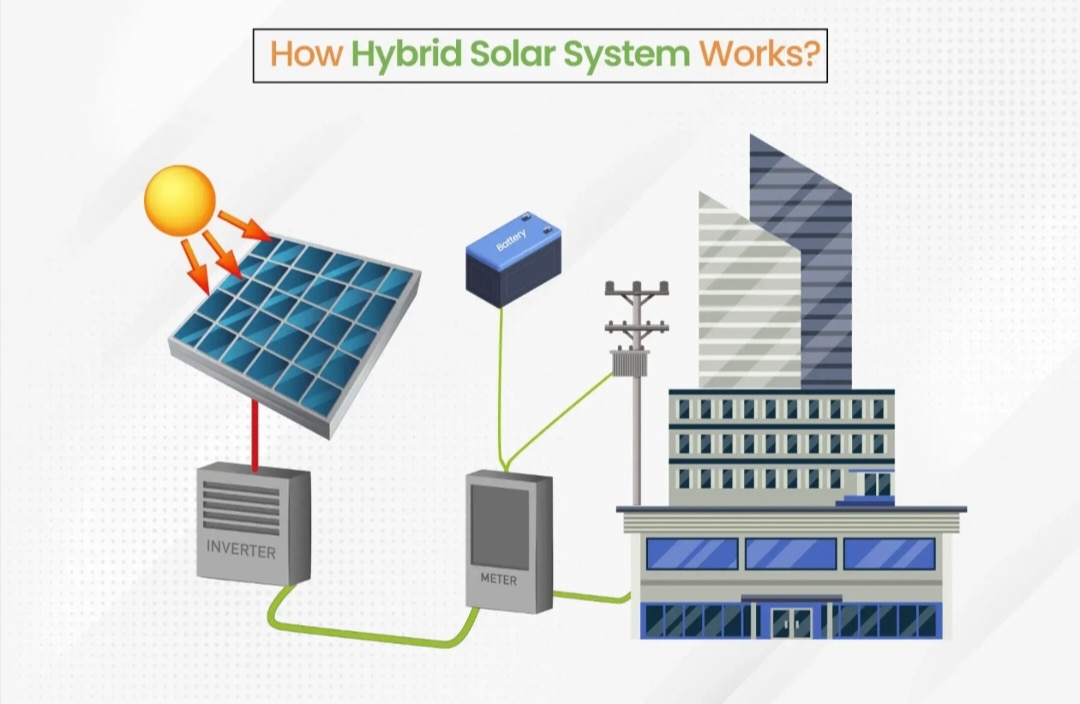
During a Jaipur grid failure, a properly configured hybrid inverter isolates your home from the utility lines through an automatic transfer switch. Its backup output then powers the selected circuits from the battery; during daylight, solar panels can run those loads and recharge the battery, but clouds, dust, shading and high demand reduce available power.
When the battery reaches its minimum state of charge, the inverter shuts off backup loads unless another source, such as a generator, is connected.
| Option | What happens during a power cut | Grid and battery position | Main consequence |
|---|---|---|---|
| On-grid | Shuts down completely under anti-islanding protection | Depends on the grid; no battery | Lower outage protection |
| Hybrid | Isolates the home and powers nominated circuits | Uses a battery, with solar recharge when available | Backup lasts only as long as stored and generated energy |
| Off-grid | Operates independently of the utility | Requires batteries and enough solar generation year-round | Higher storage and system-sizing demands |
For a hybrid solar system in jaipur, use a critical-load subpanel for lights, fans, Wi-Fi, refrigerator, CCTV and selected sockets. Leave air-conditioners, geysers, electric ovens and large pumps off the backup circuit unless the inverter and battery are designed for them.
A quotation described as a hybrid solar compan system for power failures in jaipur should state the backup output, supported circuits, battery usable capacity, autonomy hours, surge rating and what happens at minimum charge. Net metering does not provide outage power by itself.
How to Calculate Battery Size for Essential Loads
A 1.5 kW critical-load panel running for six hours needs 9 kWh of delivered energy, not a 1.5 kWh battery. Calculate energy first, then account for the battery capacity you are allowed to use and losses between the battery and appliances.
1. List every backup appliance, its running wattage, and the hours it must operate. Use measured watts where possible; add the loads that run together, then convert the total to kilowatts.
2. Calculate energy: load in kW × backup hours. For 1.5 kW × 6 hours, the result is 9 kWh.
3. Divide that energy by permitted depth of discharge and combined battery-inverter efficiency. At 80% depth of discharge and 90% efficiency: 9 ÷ (0.80 × 0.90) = 12.5 kWh of nominal battery capacity.
4. Check starting surge separately. A refrigerator, pump, or other motor can demand far more than its running watts for a few seconds. Select an inverter whose surge rating covers the largest combined startup demand; surge does not multiply the six-hour energy calculation.
5. Add design margin for battery ageing, cold or extreme heat, wiring losses, and uncertain loads. Do not count daytime solar production unless the design documents the expected PV output during an outage; clouds, dust, and shading can remove that contribution.
This method gives a defensible solar battery backup in Jaipur rather than a number based only on panel size. Confirm the battery’s usable kWh, minimum state of charge, recharge time, and warranty limits in writing.
Selected Circuits, Whole-Property Backup, and Solar Recharge
Keep backup power on circuits that protect health, communication, food, security, and basic comfort: LED lights, ceiling fans, Wi-Fi, CCTV, a refrigerator, a computer, and essential medical equipment. Leave air conditioners, geysers, electric cookers, and large pumps off backup unless the inverter and battery are designed for their high running and starting demand.
| Design | What stays powered | Capacity consequence |
|---|---|---|
| Selected circuits | Chosen lights, fans, refrigerator, router, CCTV, and medical loads | Smaller inverter and battery; longer runtime for essentials |
| Whole-property backup | Every circuit, including air conditioners, geysers, cookers, and pumps | Higher continuous watts, larger starting-surge rating, and more battery storage |
| Panels without storage | No guaranteed load during a grid failure | A grid-tied inverter normally shuts down; PV cannot supply night-time backup |
Whole-property backup costs more because the inverter must carry simultaneous loads and motor-starting surges, while the battery must store energy for every connected appliance. A selected-circuit board limits that demand and prevents one heavy appliance from draining essential backup.
During a daytime outage, a hybrid inverter isolates the property from the grid and can use solar power for running loads and charging the battery. Clouds, dust, shade, and heavy consumption reduce that recharge, so panels alone cannot guarantee power after sunset.
Ask any provider offering a hybrid solar installation in jaipur to state the backup circuits, usable battery capacity, recharge assumptions, and the exact behaviour when the battery reaches its minimum charge.
Jaipur Heat, Dust, Monsoon Weather, and Battery Choice
An unventilated rooftop battery enclosure can turn Jaipur’s heat into lost backup. High ambient temperature accelerates battery ageing, while an inverter may reduce output to protect its electronics. Install equipment under shade, away from direct rain, with airflow that stays within the manufacturer’s temperature limits.
Dust reduces panel generation and can block inverter cooling vents. Monsoon moisture adds a second risk: water entering cable glands, isolators, or battery cabinets can cause corrosion, insulation failure, or a nuisance shutdown. A weather-rated enclosure is not permission to seal the battery in a hot box.
Battery chemistry changes the maintenance burden. Lithium iron phosphate (LFP) suits frequent cycling and needs a battery-management system that limits overcharge, over-discharge, excess current, and abnormal temperature. Lead-acid batteries need more ventilation, lose usable capacity under heavy discharge, and require closer attention to terminals and electrolyte where applicable.
Compare usable kWh, cycle warranty, operating temperature, and replacement assumptions—not only the nameplate capacity.
Demand these protection features in any solar battery backup in Jaipur:
- DC and AC isolators
- Correctly rated fuses or circuit breakers
- Earthing and surge protection
- Short-circuit protection
- A labelled backup changeover or critical-load circuit
- Battery over-temperature and over-current protection
Keep service practical:
- Clean panels after dusty periods
- Clear inverter vents
- Inspect seals, cable glands, and terminals after monsoon
- Test alarms, transfer operation, and battery state of health
A hybrid solar system in Jaipur performs reliably only when its installation environment receives the same attention as its panel capacity.
What to Demand in a Hybrid Installation Quotation
Demand the figures that predict outage performance, not a panel total.
A credible hybrid solar installation in jaipur quotation names the inverter’s continuous backup output in kW, surge rating, supported circuits, expected autonomy in hours, battery nominal and usable kWh, maximum depth of discharge, inverter efficiency, and the minimum state of charge at which backup stops.
Compare quotations using the same checklist:
- A load schedule showing watts, starting surge, and each backed-up appliance
- A single-line diagram showing grid isolation, critical-load subpanel, AC/DC isolators, fuses or breakers, earthing, surge protection, and changeover
- Inverter and battery datasheets stating operating temperature, protection functions, charging limits, and recharge time
- Written warranty terms covering labour, battery capacity retention, inverter replacement, exclusions, and response time
- A commissioning report with test results, labels, settings, and the procedure used when the battery reaches minimum charge
| Quotation field | Provider A | Provider B |
|---|---|---|
| Backup output | Continuous and surge kW | Continuous and surge kW |
| Battery | Usable kWh, chemistry, DoD | Usable kWh, chemistry, DoD |
| Outage scope | Named circuits and loads | Named circuits and loads |
| End of discharge | Automatic grid return or shutdown | Automatic grid return or shutdown |
| Protection | Isolation, over-current, earthing, SPD | Isolation, over-current, earthing, SPD |
SOLSKEN ENERGY LLP can fit this decision if its proposal documents those figures instead of relying on “hybrid” as a label. Reject any solar compan in jaipur that will not identify the backup output or supported circuits, even if its price is lower.
Ask specifically whether the design is a hybrid solar compan system for power failures in jaipur, rather than grid-tied solar with no battery-backed island output.
Related product
 | Hybrid Solar System Installation Hybrid Solar System Installation Solsken Energy LLP provides advanced Hybrid Solar System Installation services for homes, businesses, and industrial facilities seeking reliable,... |
Frequently asked questions
What happens during a Jaipur power cut with a hybrid solar system?
The hybrid inverter isolates your property from utility lines through an automatic transfer switch, then supplies selected backup circuits from the battery. Solar panels can power those circuits and recharge the battery during daylight.
How do you calculate battery size for essential loads?
Add the running wattage of the appliances you will use, multiply by required backup hours, then divide by inverter efficiency and the battery’s permitted depth of discharge. Add starting-current requirements for motors, pumps, and refrigerators.
Should you back up selected circuits or the whole property?
Selected circuits require a smaller inverter and battery, while whole-property backup costs more and must handle simultaneous loads and motor starting currents. List essential circuits before requesting a quotation.
How do Jaipur’s heat, dust, and monsoon affect battery choice?
Place batteries in a shaded, dry, ventilated location within the manufacturer’s temperature range. Ask for the battery’s operating temperature, enclosure rating, cycle warranty, depth-of-discharge limit, and maintenance requirements.
What should a hybrid solar installation quotation include?
Require panel and inverter models, battery capacity, usable energy, backup circuits, transfer-switch details, protection devices, cable sizes, mounting method, earthing, monitoring, installation scope, warranty terms, commissioning tests, and after-sales support.
Keywords