
An on-grid installation must match your electricity consumption, sanctioned load, roof conditions, and Rajasthan’s approval process; roof size alone cannot produce a reliable design. By the end, you will know how power moves through the system, which documents and bill figures matter, how to compare system types, and what to demand from an installer before signing.
Key takeaways
- Use 12 months of electricity bills before choosing system capacity.
- Confirm Rajasthan net-metering steps before ordering equipment.
- Check roof shade, structure, cable routes and inverter location.
- Choose hybrid or off-grid when backup power matters more than lower cost.
How an on-grid system moves electricity on a Jaipur property
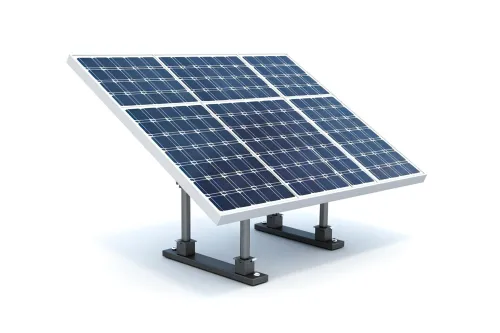
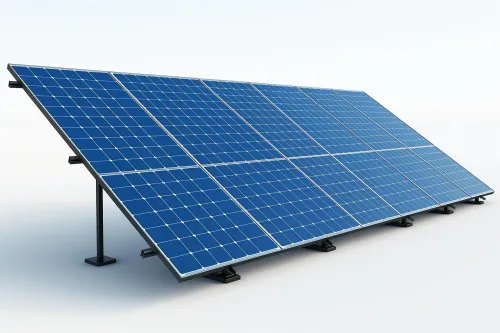
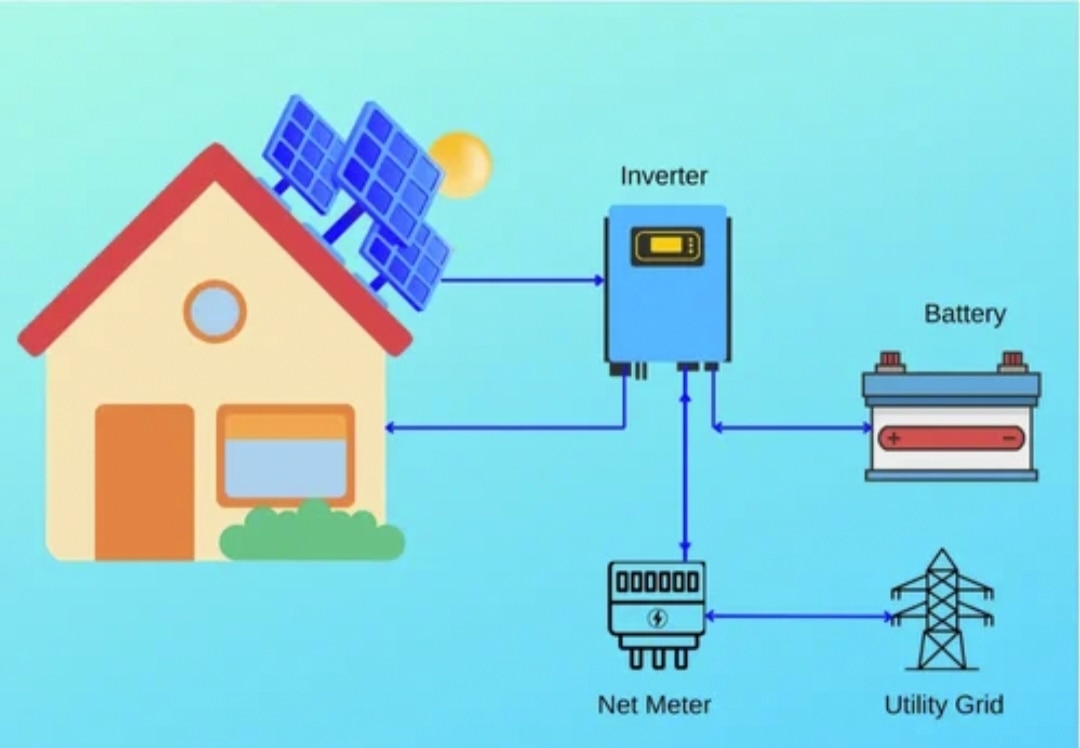
Solar panels on the roof convert sunlight into direct-current electricity. The inverter changes it to grid-compatible alternating current, matches the utility’s voltage and frequency, and sends it through the property’s distribution board. A generation meter records total solar production; a bidirectional net meter records electricity imported from and exported to the grid.
An on-grid solar system in Jaipur normally has no battery. Power reaches the property’s appliances first, so the roof supplies daytime demand before any surplus travels through the net meter, the service line, the local distribution transformer and the utility grid.
- When solar production exceeds on-site demand, the surplus flows outward through the bidirectional net meter. The meter records exported units for settlement under the approved net-metering arrangement.
- When demand exceeds solar production, the property draws the shortfall from the grid. The net meter records those imported units.
- At night, the panels produce nothing, so the property takes its electricity from the grid unless a separate battery system exists.
A solar panel in Jaipur does not keep appliances running during a grid outage. Anti-islanding protection disconnects the inverter as soon as the utility supply fails, protecting line workers from energised wires. Backup requires a hybrid inverter, batteries and a dedicated backup-load circuit.
The inverter, protection devices, earthing and meter connection must match the approved phase configuration and utility requirements. This is why a roof survey alone cannot explain the final electricity path: the installer must also verify the service panel, cable route, sanctioned connection and grid tie point.
The Rajasthan net-metering process, from application to synchronization
Use the electricity bill to identify the utility before applying. Jaipur properties in Jaipur Vidyut Vitran Nigam Limited (JVVNL) territory follow JVVNL’s process; properties served by another distribution company must use that company’s route. The national rooftop-solar portal can route the application, but the DISCOM remains responsible for feasibility, inspection and grid approval.
Prepare these records before submission:
- Latest electricity bill, consumer number, sanctioned load and phase details
- Aadhaar or other accepted identity proof, mobile number and email
- Property ownership proof or the owner’s written roof-use consent
- Bank account details for any eligible subsidy claim
- Vendor registration details, proposed capacity, module and inverter specifications, and single-line diagram
| Stage | What you do | What the DISCOM provides |
|---|---|---|
| Application | Submit the rooftop application, select the consumer account and upload the requested records | Application number and technical-feasibility decision |
| Installation | Use the approved or eligible vendor after approval; retain invoices, serial numbers and test reports | Permission to proceed under the sanctioned capacity |
| Inspection | Request inspection after installation; keep the system accessible and protection equipment visible | Inspection report or a defect list requiring correction |
| Metering | Submit corrected documents and pay the applicable meter or processing charge | Bidirectional net meter, or approval to replace the existing meter |
| Synchronization | Let the DISCOM seal and record the meter; do not energise the export connection beforehand | Commissioning or net-metering agreement and permission to operate |
The installer should correct inspection objections, not bypass them. Synchronization requires anti-islanding protection and a recorded meter reading; only then does the on grid solar system in Jaipur have an approved export connection.
How to size the system from bills, load and property use
Start with the property’s actual electricity use, not a universal kilowatt recommendation: collect 12 months of bills and, if available, 15-minute interval data. Size generation against annual kWh, then test whether the roof and daytime load can use it.
1. Calculate the average monthly consumption and mark the daytime share. A home that uses 600 kWh monthly but consumes most of it after sunset needs a different capacity from a shop using the same energy between 9 a.m. and 6 p.m.
2. Ask for a proposal showing expected generation for each month, its temperature, dust, wiring, inverter, mismatch, shading and downtime losses, and the resulting AC energy. Module nameplate kW is not delivered energy; multiplying kW by 24 hours by 365 days produces a misleading result.
3. Check the sanctioned load, single- or three-phase connection, roof orientation, shadow-free area, roof age and usable mounting space. A larger array is not automatically better: excess export can reduce savings when nighttime consumption is high or the applicable DISCOM export limit is restrictive.
4. Compare the proposed capacity with the property’s load pattern and the current export rules before approving it. Commercial and industrial sites must also model demand charges, power factor, transformer limits and captive daytime consumption.
5. Require the quote to identify the exact modules, inverter, mounting structure and protection equipment. Do not treat a “25-year warranty” on a solar panel in Jaipur as coverage for inverter replacement, installation labour or roof waterproofing.
Jaipur site conditions, maintenance and the handover file
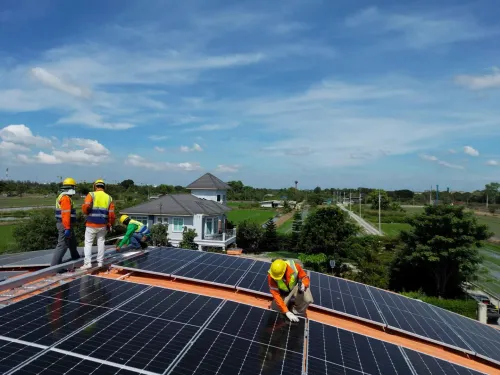
A site survey must prove that the roof can carry the array and that the system can be maintained safely. Require shade readings at morning, noon and afternoon, across seasons; a satellite image cannot reveal nearby construction, parapets or water tanks.
Check roof age, structural condition, waterproofing responsibility, cable routes, inverter ventilation, earthing, lightning protection and safe access for cleaning.
- Before accepting the installation, verify the module layout, tilt, orientation, row spacing and clearance above the roof. Confirm that no panel sits in regular shade, and inspect conduits for UV protection, secure supports and sealed roof penetrations.
- Test and record open-circuit voltage, operating voltage, string current, insulation resistance, earthing resistance and inverter operation. Ask for the commissioning date, generation-meter reading and net-meter serial number.
- Agree on a written maintenance plan: cleaning intervals, inspection frequency, safe access, water quality and the party paying for cleaning. Dust and bird droppings create soiling and mismatch losses; abrasive dry scrubbing can damage glass coatings. Heat also reduces crystalline-silicon output by about 0.3%–0.5% per 1°C above rated cell temperature.
The handover file must name every module, inverter, mounting component and protection device, with serial numbers, datasheets, single-line diagram, as-built cable route, test reports, manuals, commissioning or net-metering papers and emergency contacts. Separate module product, module performance, inverter, workmanship and waterproofing warranties; a “25-year warranty” rarely covers all five.
Ask the solar installer in Jaipur to sign these responsibilities before final payment.
Choosing between on-grid, hybrid and off-grid systems
If your priority is the lowest daytime electricity cost and the grid is dependable, choose on-grid. It has no battery, exports surplus power, and shuts down during a grid failure because anti-islanding protection disconnects the inverter.
| Option | What it means | When it fits |
|---|---|---|
| On-grid | Solar inverter works with the utility grid; no backup during an outage | Stable supply, daytime consumption, and a tariff where exported energy has value |
| Hybrid | Solar, grid, battery, and a protected backup-load circuit work together | Frequent outages, critical lights, routers, pumps, or refrigeration |
| Off-grid | Solar and batteries operate without the utility; a generator may provide additional support | No grid connection or a site where extending the grid is impractical |
A hybrid system does not keep every appliance running automatically. Ask the designer to identify the backed-up circuits, battery usable capacity, recharge time, and the loads that will be excluded.
Require a solar company in Jaipur to name the exact modules, inverter, mounting structure, isolators, surge protection, earthing, and cables in the contract. Separate the module product warranty, module performance warranty, inverter warranty, workmanship warranty, and roof-waterproofing responsibility; “25 years” rarely covers all five.
Your solar installer in Jaipur should complete a shade study, roof and structure inspection, cable-route plan, ventilation check, and maintenance-access review. For commercial premises, demand charges, three-phase connection, power factor, transformer limits, and daytime load matter more than a residential per-unit calculation.
SOLSKEN ENERGY LLP should be judged against this same written scope, not a panel count alone.
Related product
 | On-Grid Solar System Installation On-Grid Solar System Installation Solsken Energy LLP offers professional On-Grid Solar System Installation services for residential, commercial, and industrial properties, helping... |
Frequently asked questions
How does an on-grid solar system move electricity on a Jaipur property?
Panels produce direct-current electricity, the inverter converts it to grid-compatible alternating current, and the property uses that power through its distribution board. A generation meter records solar output, while a bidirectional net meter records electricity imported from and exported to the grid.
What is the Rajasthan net-metering process for an on-grid solar system?
The process runs from application and document submission through utility review, installation, inspection, meter replacement or commissioning, and synchronization with the grid. Confirm the current procedure and required documents with the relevant Rajasthan electricity distribution company before installation.
How do you size an on-grid solar system from electricity bills?
Review 12 months of bills, calculate average monthly consumption, identify seasonal peaks, and assess daytime usage. Then compare the target solar generation with roof area, available sunlight, sanctioned load and the system capacity permitted for the connection.
What should Jaipur property owners check before installation and handover?
Inspect roof condition, shade from nearby buildings and trees, mounting security, drainage, cable protection, earthing and inverter ventilation. Request a handover file containing equipment warranties, datasheets, test results, single-line diagram, approvals, commissioning records and maintenance instructions.
When is hybrid or off-grid solar better than an on-grid system?
Choose hybrid solar when you need battery backup during grid outages while retaining grid connection. Choose off-grid solar when the property lacks dependable grid service and can support batteries, load management and generator or other backup planning.
Keywords