A business cannot size a solar plant safely from roof area alone: interval consumption, sanctioned load, transformer capacity, roof structure, heat, dust, and export rules all affect the result. By the end, you will know what an EPC scope must include, which property data to prepare, how to compare system and financing options, and how to test and maintain the finished plant.
Key takeaways
- Check roof strength, shade, sanctioned load, and daytime electricity use.
- Compare EPC quotes by equipment, warranties, safety scope, and performance guarantees.
- Choose cash purchase, loan, lease, or PPA based on cash flow and control.
- Demand test records, as-built drawings, warranties, and a maintenance plan at handover.
What a commercial solar EPC actually delivers
A commercial solar EPC delivers one accountable project scope: engineering, procurement, and construction from electricity-bill review to tested, documented handover. It is not a job that ends when modules and inverters are fixed to a roof.
1. Start with recent bills, sanctioned load, contract demand, available interval data, and a site survey. Analyse daytime loads, demand charges, roof area, shading, access, drainage, waterproofing, and maintenance routes.
2. Engineer the system around the load profile, not maximum roof coverage. The design covers DC and AC capacity, module and inverter selection, mounting, cable routes, three-phase switchboard integration, transformer interface, earthing, lightning protection, isolators, fuses, surge protection, and anti-islanding settings.
3. Procure specified equipment and secure approvals. The EPC coordinates utility requirements, metering, export arrangements, structural review, ballast or anchor calculations, fire access, and roof-loading limits.
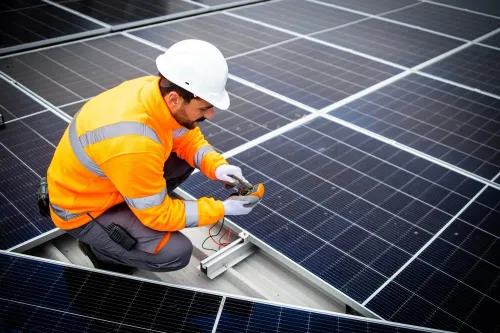
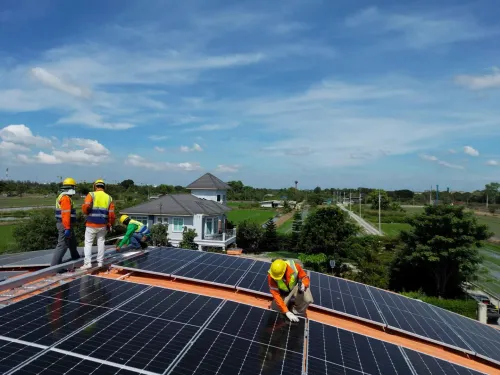
4. Construct the array, inverter room, protection equipment, walkways, labels, and monitoring system while coordinating planned shutdowns. Commercial solar installation in Jaipur involves larger capacities, three-phase infrastructure, transformer interfaces, rooftop loading, and business-continuity controls than residential work.
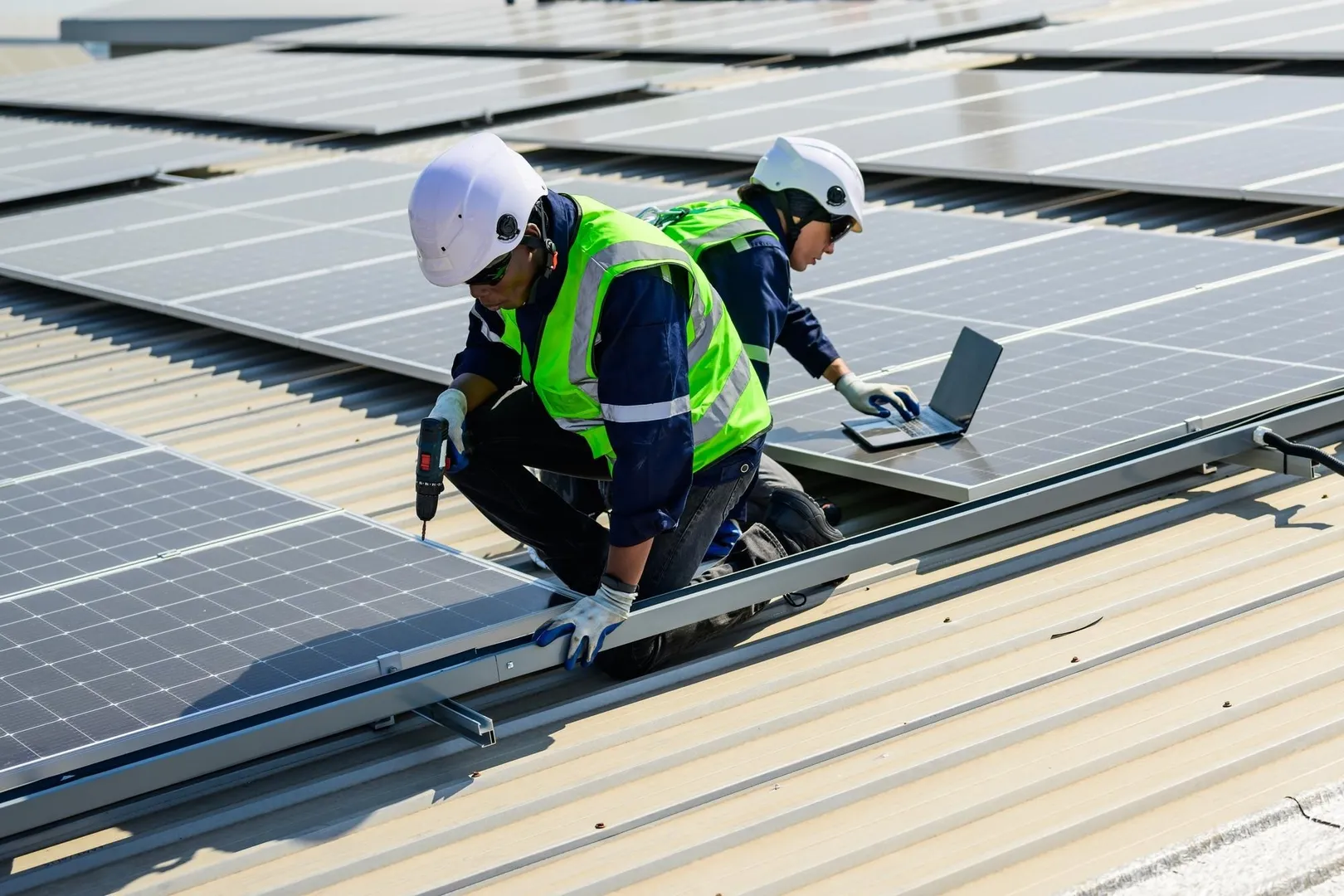
5. Test insulation resistance, polarity, continuity, earthing, torque, protection, synchronisation, metering, and monitoring. Then provide as-built drawings, settings, manuals, warranties, test records, and operating instructions at handover.
Solar EPC in Jaipur does not turn a grid-connected array into emergency power. The inverter must disconnect during an outage; backup requires batteries and an islanding-capable architecture designed for essential loads, fire access, and safe maintenance.
How to decide whether your Jaipur property fits solar
A viable solar EPC in Jaipur starts with your load and grid connection, not the square metres of roof. Give the designer 12 months of electricity bills, sanctioned load, contract demand, 15-minute interval data, the single-line diagram, roof drawings, ownership or lease documents, transformer and meter details, and the available interconnection point.
| Check | Compare | Why it changes size |
|---|---|---|
| Daytime load | Interval consumption and avoided electricity cost | Limits surplus export and improves self-consumption |
| Electrical limit | Sanctioned load, contract demand and interconnection capacity | Prevents an oversized AC system |
| Roof capacity | Shadow-free area, structure, drainage and access | Sets safe, maintainable panel capacity |
A site survey must record roof age and condition, structural capacity, waterproofing, drainage, wind exposure, walkways, and access for cleaning and emergency inspection. Ballast adds dead load and wind uplift; anchors can breach waterproofing. Demand the calculations and repair responsibilities in writing.
Jaipur conditions reduce real yield and affect layout:
- Include summer cell-temperature losses; crystalline-silicon modules lose roughly 0.3%–0.4% per 1°C above the 25°C rating condition.
- Check dust and soiling, hard-water deposits, and cleaning access; dry abrasive brushing can scratch glass.
- Keep monsoon drainage clear and model shadows from parapets, tanks, lift rooms, and neighbouring buildings.
Choose capacity from interval load, avoided cost, sanctioned load, and interconnection limits. Filling every roof area can create low-value exports, not a better investment.
Which system and financial arrangement suits the business
Choose an on-grid system when your business consumes power during daylight and outages do not stop critical operations. Choose a hybrid system only when backup continuity or peak-demand control justifies batteries; a grid-connected inverter shuts down during an outage unless islanding-capable equipment is installed.
| Option | Best fit | Main trade-off |
|---|---|---|
| On-grid rooftop | Daytime loads and usable roof area | No outage backup; export rules affect returns |
| Hybrid rooftop | Critical loads, outage protection, or peak shifting | Battery, fire protection, controls, and replacement add cost |
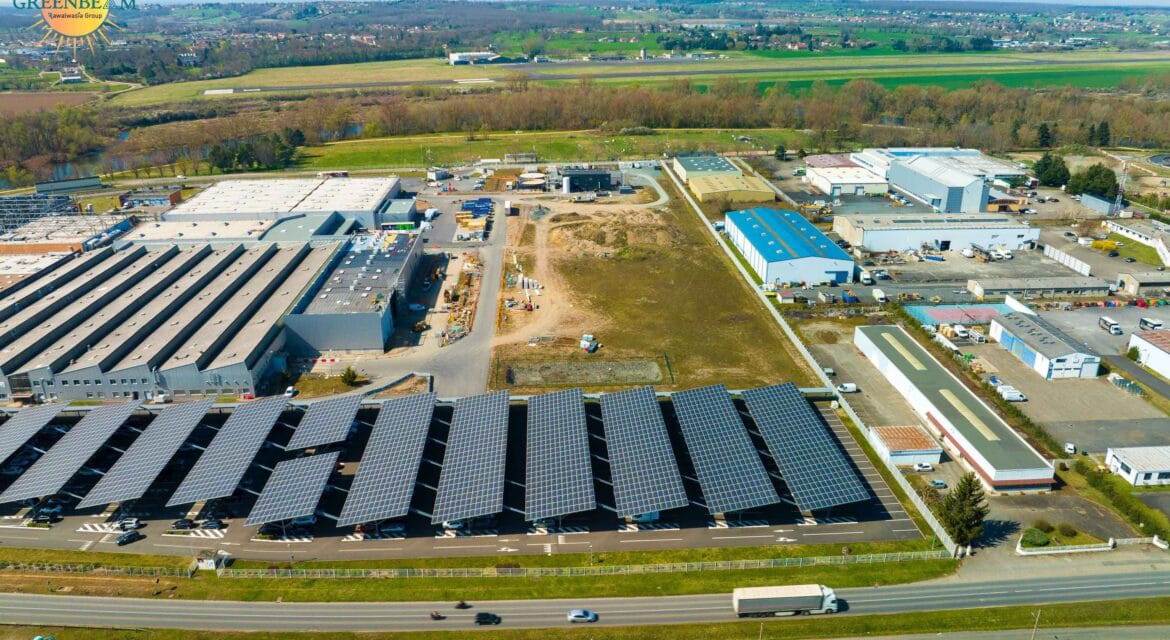
| On-grid carport | Limited roof capacity or shaded parking areas | Higher structure and drainage costs; parking access needs planning |
| Solar-only generation | Loads closely match solar hours | Surplus energy depends on export compensation |
Direct self-consumption is more valuable than battery shifting when solar output coincides with production, cooling, pumps, or daytime office loads. Battery economics change with the tariff structure, demand peaks, outage requirements, round-trip efficiency, usable depth of discharge, replacement cycle, fire protection, and control strategy.
Require every commercial solar company proposal to state whether its financial model assumes net metering, gross metering, net billing, or no export under Rajasthan Electricity Regulatory Commission and Jaipur distribution-utility rules. Do not apply residential PM Surya Ghar subsidy assumptions to a commercial site.
Compare avoided purchases, demand-charge effects, depreciation and tax advice, and financing cost. A capital purchase avoids loan interest; financed procurement preserves cash but reduces returns through interest and fees.
What to demand from a commercial EPC quotation
Demand a quotation that lets you compare engineering decisions, risk, and exclusions—not just a total price. A solar company in Jaipur that omits these details leaves you unable to test its yield or scope.
1. Record DC module capacity in kWp, AC inverter capacity in kW, and the DC-to-AC ratio. Require module and inverter makes and models, module efficiency, inverter topology, mounting material, cable sizes and insulation ratings, isolators, fuses, surge protection, earthing, lightning protection, monitoring, and the interconnection point.
2. Require the annual-generation method, not one unexplained kWh figure. The model must show temperature, soiling, mismatch, inverter, wiring, shading, availability, degradation, and curtailment losses, plus central and conservative cases and the irradiation data or comparable site used.
3. Separate the module product warranty and module degradation warranty from inverter warranty, workmanship period, roof-leakage liability, response time, labour, and replacement-logistics obligations. State exclusions and who pays for diagnosis, access equipment, transport, and defective-part replacement.
4. Check taxes, exclusions, approval responsibility, shutdown coordination, payment milestones, and handover deliverables. These should include as-built drawings, single-line diagrams, protection settings, test records, manuals, serial numbers, warranties, and operating instructions. Use this checklist when comparing proposals from SOLSKEN ENERGY LLP or any other commercial solar company.
Related product
 | Commercial Solar Installation Commercial Solar Installation Solsken Energy LLP offers professional Commercial Solar Installation services for offices, retail stores, hotels, hospitals, educational... |
How commissioning and maintenance protect the investment
A commercial array is not commissioned when the inverters switch on. Require documented tests proving that the system is safe, correctly connected, approved for export, and producing against an agreed baseline.
- Record insulation-resistance results for DC circuits, earthing and protective-conductor continuity, string polarity, and torque values for terminals, busbars, isolators, and mounting connections.
- Test inverter protection, including anti-islanding and disconnection under abnormal grid conditions. Complete meter and monitoring validation, synchronize with the utility, and obtain the required utility approvals before export.
- Confirm that durable AC and DC labels, emergency isolation instructions, and the current single-line diagram are fixed on site. DC circuits can remain live in sunlight after AC shutdown, so unclear isolation instructions create a serious maintenance risk.
- Demand a handover pack containing as-built drawings, protection settings, equipment manuals, serial numbers, warranties, test records, and cleaning and shutdown procedures.
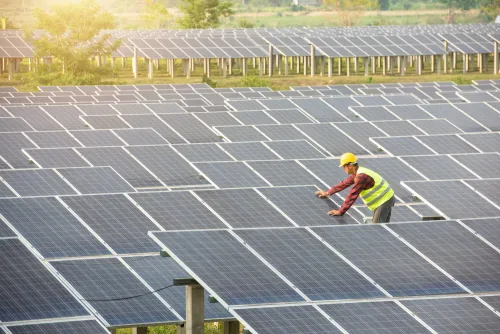
- Schedule visual inspections, connector and cable-support checks, thermographic inspection, inverter alarm and firmware reviews, surge-protection status checks, drainage and obstruction checks, production benchmarking, and periodic insulation and earthing tests. Compare infrared and electrical findings with commissioning records.
- Set cleaning intervals from measured production loss, Jaipur dust, water quality, roof access, and the module manufacturer’s instructions. Avoid dry abrasive brushing, which can scratch glass or coatings, and untreated hard water, which can leave mineral deposits.
- Keep module product and degradation warranties separate from inverter, workmanship, roof-leakage, labour, response-time, and replacement-logistics obligations.
Frequently asked questions
What does a commercial solar EPC company deliver?
A commercial solar EPC delivers engineering, procurement, construction, testing, documentation, and handover as one accountable project scope.
How do I decide whether my Jaipur commercial property suits solar?
Review roof condition and strength, shade, available area, electricity consumption, sanctioned load, and applicable grid-connection requirements.
Which financial arrangement suits a commercial solar system?
Compare a cash purchase, business loan, lease, and power purchase agreement against your cash flow, ownership goals, tax treatment, and maintenance responsibilities.
What should a commercial solar EPC quotation include?
Demand the system design, module and inverter models, capacity assumptions, structural and electrical scope, approvals, warranties, exclusions, schedule, payment terms, and performance commitments.
How do commissioning and maintenance protect a commercial solar investment?
Commissioning verifies generation and safety before handover, while inspections, cleaning, monitoring, fault response, and documented maintenance help preserve system performance.
Keywords